
In the backcountry, weight is the enemy. A heavy pack slows your pace, burns your energy, and turns an enjoyable hike into a grueling slog. Financial debt acts exactly the same way. It is the dead weight in your backpack that keeps you from moving freely toward your financial summit.
At Mountain Goat Wealth Management, we know that shedding this weight is the first step to agility. But when you are staring up at a mountain of obligations, where do you start? Do you attack the steepest section first, or do you build momentum on the easier slopes?
Here are two proven routes to clear the path: The Avalanche and The Snowball.
Route 1: The Debt Avalanche- The Aggressive, Efficient Line
Imagine a massive snow slide clearing everything in its path. The Debt Avalanche strategy is designed for the climber who wants the fastest, most mathematical route to the top. It prioritizes efficiency over everything else.
The Strategy
- Target the Rate: List your debts in order of interest rate, from highest to lowest.
- Ignore the Size: It doesn’t matter if the balance is big or small; if the interest rate is high, it goes first.
- Attack: You pay the minimums on everything else and throw every extra dollar at the debt with the highest rate.
The Result
This is the fastest way out of debt mathematically. By eliminating the highest interest rates first, you stop the compound interest from accumulating against you.
Route 2: The Debt Snowball The Momentum-Building Approach
Sometimes, the climb is mental. If you are feeling discouraged, you need a quick victory to prove to yourself that you can make it. The Debt Snowball is about starting small and letting gravity do the work as you build momentum.
The Strategy
- Target the Size: List your debts from smallest balance to largest balance.
- Ignore the Rate: Forget the interest percentages for a moment. Your goal is simply to clear a line item off your ledger.
- Attack: Attack the smallest debt with intensity while paying minimums on the rest.
The Result
This method allows you to celebrate “fast wins”. Crossing a debt off your list completely provides a psychological boost that fuels you for the larger obstacles ahead.
Trail Guide: Seeing the Difference
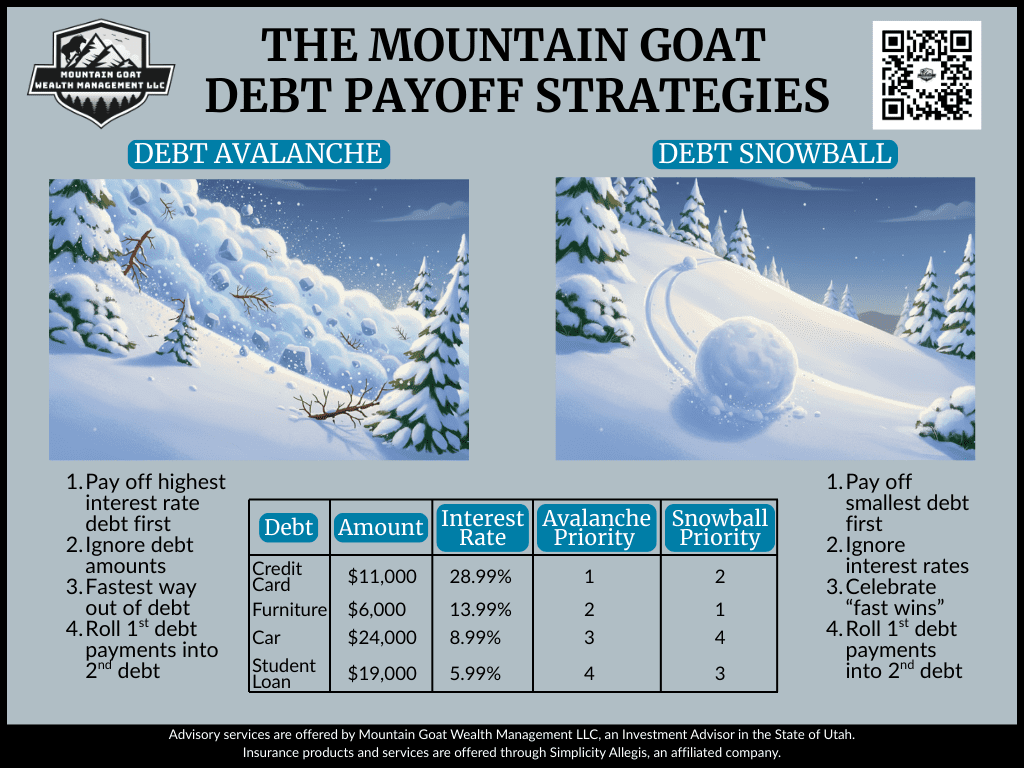
Let’s look at a hiker’s backpack containing four specific rocks (debts) to see how these strategies differ in practice.
The Debt Load:
- Credit Card: $11,000 at 28.99%
- Furniture: $6,000 at 13.99%
- Car: $24,000 at 8.99%
- Student Loan: $19,000 at 5.99%
The Avalanche Route (Priority by Rate): If you choose the Avalanche, you are attacking the most dangerous terrain first. Your priority order is:
- Credit Card (Highest Rate: 28.99%)
- Furniture (13.99%)
- Car (8.99%)
- Student Loan (5.99%)
The Snowball Route (Priority by Size): If you choose the Snowball, you want to clear the small obstacles to build confidence. Your priority order shifts:
- Furniture (Smallest Balance: $6,000)
- Credit Card ($11,000)
- Student Loan ($19,000)
- Car (Largest Balance: $24,000)
Notice that the Car and Student Loan swap places depending on the strategy, as does the Furniture.
The Crux Move: Rolling the Payments
Regardless of which route you choose, the secret to success is the “Roll Over.” Once you conquer that first debt, you don’t put that money back in your pocket. You take the entire payment amount you were using for the first debt and roll it into the second debt.
This creates an accelerating effect—like a snowball growing in size or an avalanche gaining speed—until your debts are wiped out and your pack is light enough to run for the summit.
Which route suits your climbing style? Let’s discuss it at our next checkpoint.