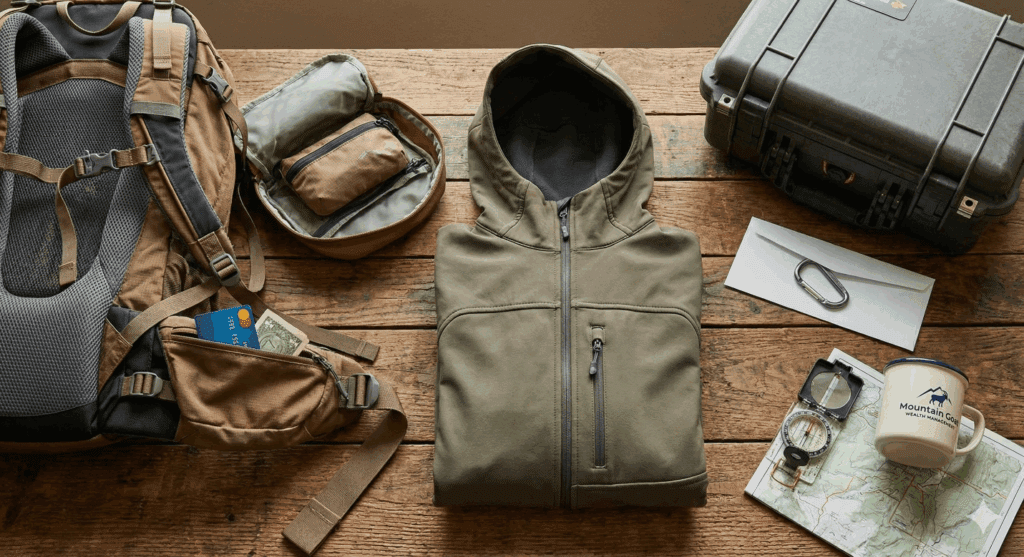
When packing for a long expedition, you don’t throw everything into one big duffel bag. You have your hip belt pockets for snacks you need now, your top lid for gear you might need by lunch, and the deep storage for the supplies you won’t touch until base camp.
Organizing your cash is no different. It’s not just about hoarding resources; it’s about accessibility and efficiency. Keeping all your money in a low-interest checking account is like trying to pack everything into the hip belt pockets—it’s just not supposed to work that way.
Here is your guide to the five essential “pockets” for your cash, and how to use them to keep your financial climb efficient.
1. Checking: The Hip Belt Pocket
Think of your Checking Account as the pockets on your hip belt. It is designed for high-frequency use.
- The Terrain: Day-to-day transactions, bills, and coffee stops.
- The Advantage: Maximum accessibility. You can grab your funds instantly via debit cards, checks, or transfers.
- The Trade-off: The “return” on this gear is virtually zero. Interest rates are low to non-existent. It’s a pass-through account, not a storage unit.
2. Savings: The Top Lid
Your standard Savings Account is like the top lid of your pack. It’s still easy to reach, but you aren’t dipping into it every five minutes.
- The Terrain: Short-to-medium term cash holding, like saving for a vacation or annual subscriptions.
- The Advantage: It keeps your “spending money” separate from your “keeping money,” preventing you from accidentally spending next month’s mortgage on a new pair of boots.
- The Trade-off: While better than checking, the interest rates are generally still low. It’s safe, but it won’t get you up the mountain much faster.
3. Money Market: The Hybrid Layer
A Money Market account acts like a hybrid soft-shell jacket—versatile enough for different conditions.
- The Terrain: A place to hold an emergency fund or down payment savings while still needing some access.
- The Advantage: It often offers variable interest rates that can beat a standard savings account, yet you can still write checks or use a debit card in a pinch.
- The Trade-off: Watch out for the weight limits. These accounts often require higher minimum balances (sometimes thousands of dollars) to avoid fees.
4. High-Yield Savings: The Base Camp Cache
Now we are getting serious about efficiency. A High-Yield Savings account is like a cache you’ve set up at base camp. You can’t reach it instantly while you are hiking, but it’s growing in value while it sits there.
- The Terrain: Perfect for your main Emergency Fund or large upcoming purchases.
- The Advantage: Interest rates here are significantly higher than standard savings accounts. Your money is working hard while you sleep.
- The Trade-off: Accessibility is slightly slower. It usually exists online, meaning you may need to wait a day or two for a transfer to hit your checking account.
5. Certificate of Deposit (CD): The Buried Supply
A CD is a supply drop locked at a specific GPS coordinate. You know exactly where it is and what it’s worth, but you can’t open it until you arrive at that specific time.
- The Terrain: Saving for a specific expense with a known date, like a wedding or a planned gear upgrade next year.
- The Advantage: Generally, offers the highest fixed interest rates among cash accounts. It is predictable and secure.
- The Trade-off: Your funds are locked for the term (3 months to 5 years). If you try to “break the lock” early, you will pay a penalty.
Pack Smart, Climb Strong
You wouldn’t climb a mountain in flip-flops, and you shouldn’t let your emergency fund sit in a zero-interest checking account. By placing your cash in the right containers, you ensure you have liquidity when you need it and growth when you don’t.
Unsure if your cash is packed efficiently? Let Mountain Goat Wealth Management do a gear check on your portfolio. We’ll help you make sure every dollar is pulling its weight on the ascent.