
In the high alpine, resource management is the difference between a successful summit and a forced retreat. Mountain goats survive in harsh environments because they are efficient; they know exactly how much energy to expend and how much to reserve for the steep climbs ahead.
In your financial life, the question “Am I saving enough?” is equivalent to asking, “Do I have enough oxygen and fuel to make it to the top?” At Mountain Goat Wealth Management, we use a specific metric to measure this: your Retirement Investment Rate.
Let’s break down the math of the mountain to see how your preparations score.
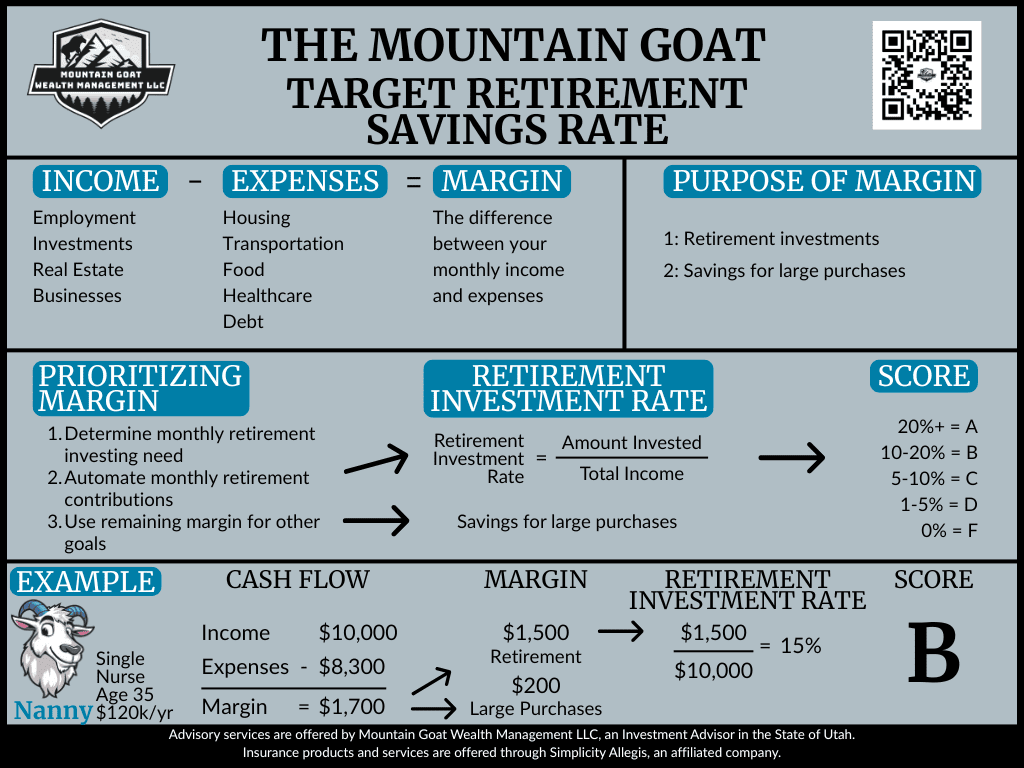
The Base Equation: Finding Your Margin
Before you can determine your climbing pace, you need to know what resources you have available. It starts with a simple calculation of your cash flow.
Income – Expenses = Margin
- Income: This is your supply intake. It includes employment earnings, investments, real estate income, and business revenue.
- Expenses: This is the weight in your pack. It includes housing, transportation, food, healthcare, and debt.
The difference between these two is your Margin. This is the “fuel” you have left over after survival needs are met.
Purpose of Margin: Choosing Your Route
A novice climber might blow their margin on heavy luxuries that don’t help the ascent. A pro knows that margin has two specific purposes:
- Retirement Investments: Fuel for the long haul.
- Savings for Large Purchases: Gear upgrades or near-term objectives.
To ensuring you are climbing efficiently, we recommend Prioritizing Margin in this order:
- Determine the Need: Figure out exactly how much monthly investment is required to reach your summit.
- Automate It: Set up automatic monthly retirement contributions so you don’t have to think about it.
- The Remainder: Use the remaining margin for other goals.
The Climbing Grade: Your Retirement Investment Rate
How fast are you ascending? We calculate your Retirement Investment Rate by taking the Amount Invested divided by your Total Income.
Once you have your percentage, check the Score to see how your pace compares to the ideal ascent:
- 20%+ (Grade A): You are a lead climber. You are moving fast and securing your future aggressively.
- 10-20% (Grade B): A solid, steady pace. You are making good progress.
- 5-10% (Grade C): You are moving, but the summit might be further away than you think. You may need to pick up the pace.
- 1-5% (Grade D): Hazardous terrain. You are barely gaining elevation.
- 0% (Grade F): You are stuck at base camp.
View from the Trail: A Real-World Example
Let’s look at “Nanny,” a 35-year-old Single Nurse, to see how she manages her pack weight.
Her Cash Flow:
- Income: $10,000/month
- Expenses: -$8,300/month
- Margin: $1,700/month
She has $1,700 of available fuel. She decides to allocate $1,500 to her retirement accounts and keeps $200 for large purchase savings.
Her Score:
$1,500 Invested \ $10,000 Income = 15%
With a 15% savings rate, Nanny scores a B. She is on a solid path to the summit, maintaining a strong pace that balances current enjoyment with future security.
What’s Your Grade?
If you calculated your score and found yourself in the “C” or “D” range, don’t panic—but do start climbing. Look at your “Expenses” list again. Can you shed some pack weight to increase your Margin? Every extra percent you automate into investments acts like a fixed rope, helping you pull yourself higher toward financial freedom.