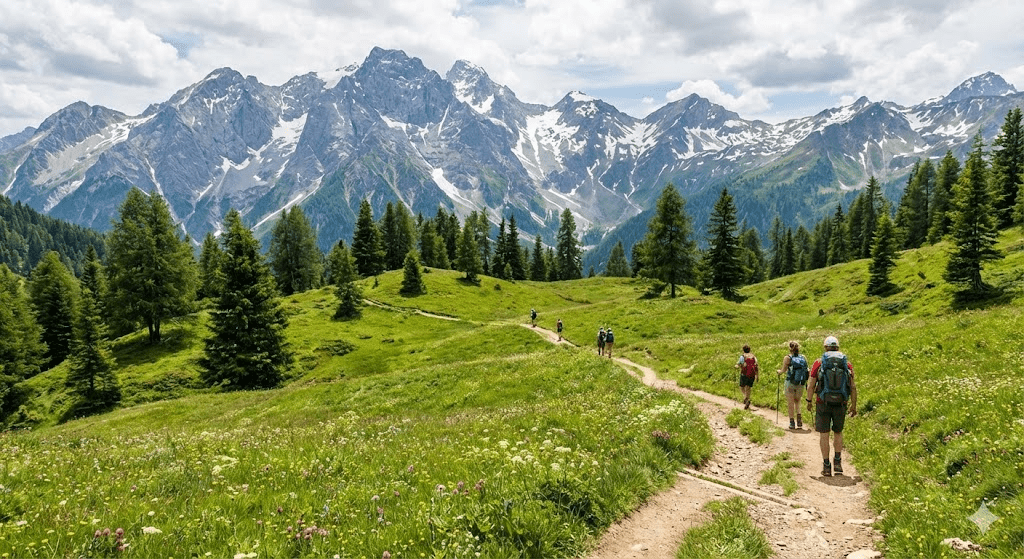
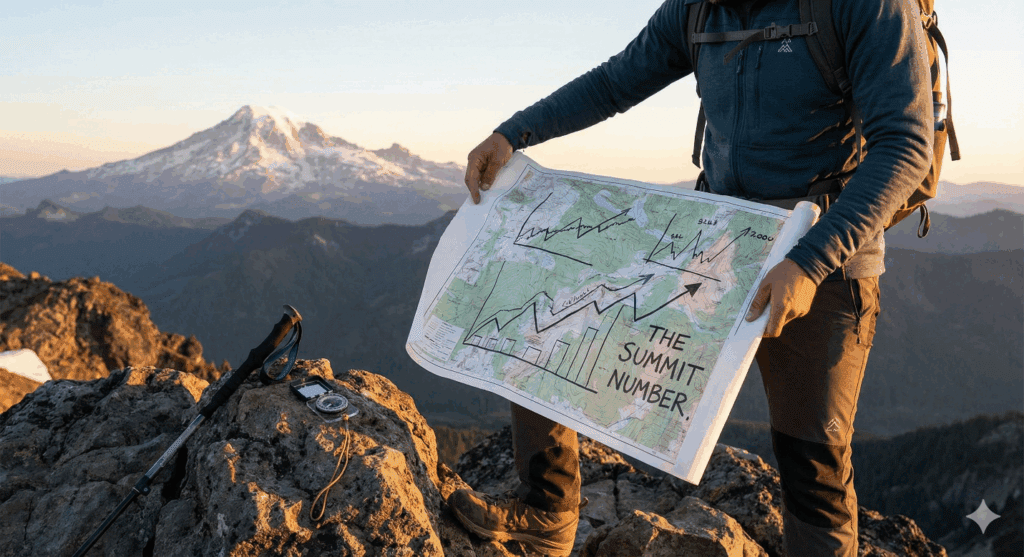
Every great expedition starts with a map. Whether you are trekking through the Dolomites or planning a multi-day ascent in the Rockies, you wouldn’t step onto the trail without knowing the elevation gain, the distance, and the supplies in your pack.
Retirement is no different. It is the summit push of your financial life. But unlike a physical mountain, the “elevation” the exact dollar amount you need—isn’t marked on a topographic map. It is a number unique to you, your lifestyle, and your appetite for adventure.
At Mountain Goat Wealth Management, we believe in being sure-footed on rocky terrain. To calculate your “Summit Number,” we don’t guess; we plot the route. Here is the four-step guide to determining exactly how much you need to retire.
Step 1: Mapping the Terrain (Your Expenses)
Before we look at your savings, we must look at your “burn rate.” How much fuel do you need to keep moving?
Start by analyzing your current monthly expenses. Look at exactly what you spend now to maintain your lifestyle. But remember, the terrain changes once you leave the workforce. You need to adjust your forecast for life at altitude:
- Dropping Weight: Some expenses will fall away like heavy gear you no longer need. You likely won’t be spending money on commuting, business attire, or perhaps a mortgage if you plan to downsize or pay it off.
- Adding Gear: Conversely, retirement is when the real adventure begins. Do you plan to travel internationally? Will you pick up expensive hobbies like skiing or photography? Don’t forget to factor in the rising cost of healthcare, which often increases as we age.
Take your current expenses, subtract the work-related costs, and add your adventure costs. This is your Projected Monthly Expense.
Step 2: Checking Base Camp Support (Fixed Income)
When you are high on the mountain, it helps to have support caches waiting for you. In financial terms, this is your guaranteed income that flows into your account regardless of what the stock market does.
Tally up all reliable monthly income streams you expect in retirement:
- Social Security benefits
- Pensions
- Net rental real estate income
- Business income
- Side hustle income (consulting, guiding, etc.)
Think of this as your hydration bladder; it keeps you going without you having to stop and filter water from a stream. This is your Total Monthly Income.
Step 3: The Crux (Calculating the Shortfall)
In climbing, the “crux” is the hardest part of the route. In retirement planning, the crux is the gap between what you need to spend and what you have coming in automatically.
The math here is simple:
[Projected Monthly Expense] – [Total Monthly Income] = The Monthly Shortfall
For example, if you determine you need $8,000 a month to live your best life, and your Social Security and rental income bring in $3,000, your Monthly Shortfall is $5,000. This is the gap your portfolio needs to bridge.
Step 4: The Summit Push (The 4% Rule)
Now that we know the gap, we can determine the size of the portfolio required to cross it safely. To do this, we use a standard navigational tool known in the industry as the Safe Withdrawal Rate, typically set at 4%.
The theory is that a properly diversified portfolio can sustain a 4% withdrawal rate (adjusted for inflation) for 30 years without running dry.
To find your total number, take your Monthly Shortfall, multiplying it by 12 to get the annual shortfall, and then divide by 4% (0.04).
The Equation:
(Monthly shortfall x 12) / 0.04 = Total Portfolio Needed
Using our previous example:
- Shortfall: $5,000/month
- Annualized: $5,000 x 12 = $60,000
- The Summit Number: $60,000 / 0.04 = $1,500,000
In this scenario, you would need a nest egg of $1.5 million to generate the income needed to cover your gap.
Let Us Be Your Guide
Calculating the number is just the beginning of the expedition. The weather changes, the terrain shifts, and markets can be as unpredictable as a mountain storm.
At Mountain Goat Wealth Management, we help you stay agile. We ensure your portfolio is equipped to handle the rocky slopes and the steep ascents so you can focus on the view from the top.
Ready to start your ascent?